Sector Trends Analysis
Which sectors will outperform in 2025? Comprehensive analysis of market trends, sector rotation, and investment strategies. Understand why metals and realty are expected to lead while energy and financial sectors remain cautious.
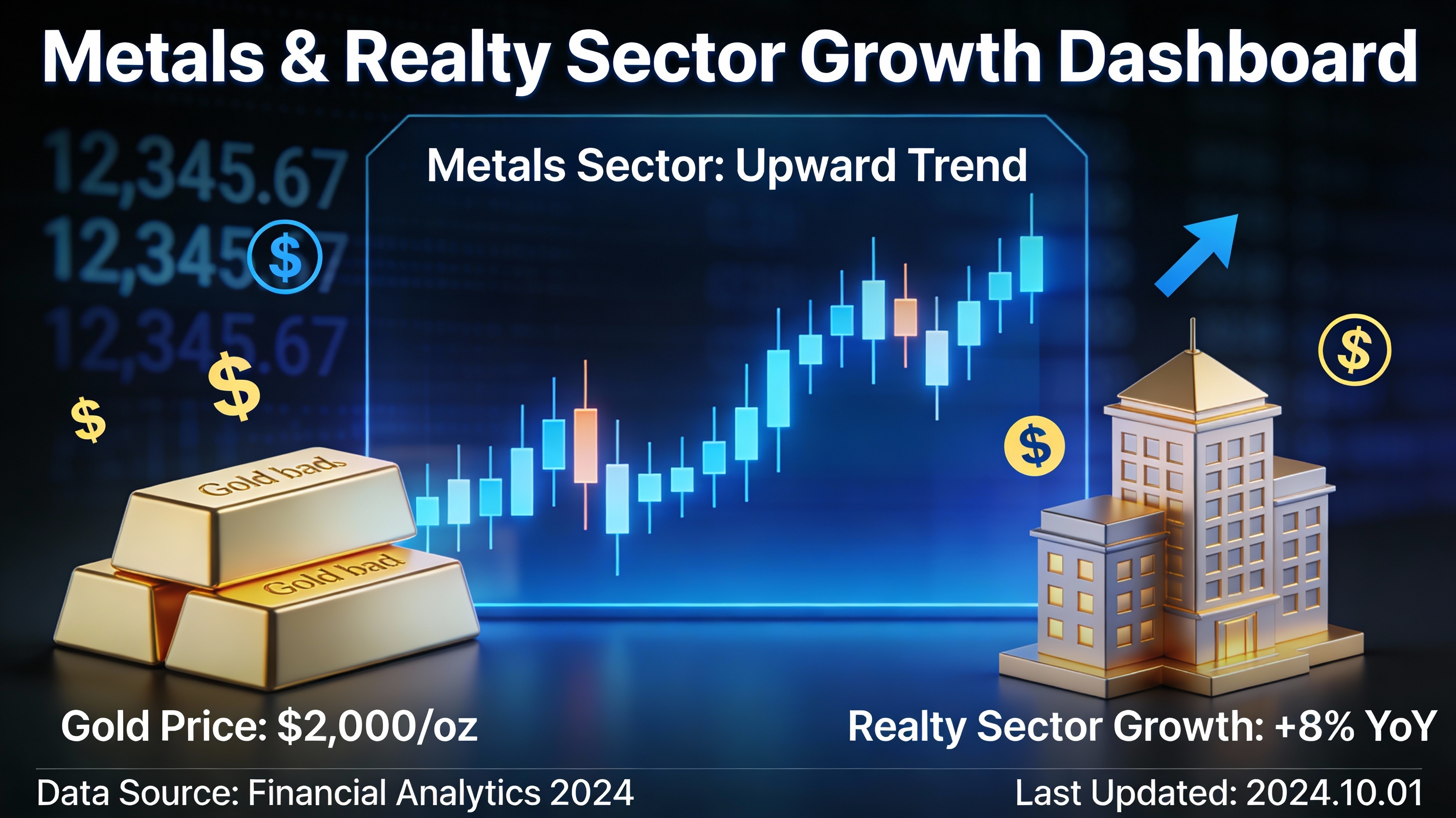
Sector Performance Outlook
Expected to Lead: Gold prices elevated due to central bank buying and inflation hedging. Steel demand supported by infrastructure projects and global recovery.
- Gold prices near all-time highs (₹13,065/gram)
- Central bank purchases exceed 900 tonnes annually
- Infrastructure spending drives steel demand
Expected to Lead: Low interest rate environment and strong urban migration create robust residential demand. Commercial real estate benefits from tech hub expansion.
- Home loan EMI pressure reduced by lower rates
- Strong migration to metropolitan areas
- Commercial spaces in high demand post-COVID
Mixed Outlook: Oil prices vulnerable to global economic slowdown. Renewable energy gains traction but traditional energy faces headwinds.
- Crude oil prices volatile amid geopolitical risks
- Renewable energy transition accelerating
- PSU oil companies face margin pressure
Cautious Stance: High valuations and NPA concerns temper enthusiasm. Interest rate cycle expectations keep sector under pressure.
- Banks trading at elevated valuations (P/E 16-18x)
- NPA resolution remains a concern for some lenders
- Deposit growth slower than loan growth
Market Highlights: Why These Trends?
Global Macro Factors
Central bank purchases, inflation concerns, and geopolitical risks support safe-haven assets like gold and metals. Economic growth expectations favor infrastructure plays.
Infrastructure Push
Government capex on roads, railways, and smart cities drives demand for steel, cement, and other commodities. Urban development projects boost real estate prospects.
Interest Rate Dynamics
Falling real interest rates (inflation-adjusted) make non-yielding assets like gold attractive. Lower borrowing costs benefit real estate developers and homebuyers.
Valuation Concerns
Financials trading at elevated P/E multiples limit upside. Energy sector faces margin compression from input costs. Metals and realty offer better risk-reward.
Sustainability Trends
Green metals (for EV batteries, solar) gain prominence. Sustainable real estate projects attract premium pricing and institutional investment.
Rotation Strategy
Portfolio rotation from defensive to cyclical sectors. Investors shifting from tech (high valuations) to commodities and realty (value plays).
Deep Dive: Sector-by-Sector Analysis
🔧 Metals & Mining: Why Lead Gains?
The metals sector is poised to be one of the strongest performers in 2025, driven by multiple structural and cyclical factors.
Gold & Precious Metals
- Gold prices near ₹13,065/gram with support building above ₹12,800
- Reserve diversification away from US dollar supports buying
- Safe-haven flows during geopolitical tensions
- Mining stocks offer leverage to gold prices
Steel & Base Metals
Steel demand supported by infrastructure projects, construction, and automotive recovery. Iron ore and copper benefit from global growth expectations.
- Infrastructure spending accelerates: roads, railways, ports
- EV boom drives demand for copper and lithium
- Global supply constraints (China production curbs) support prices
- Construction cycle in India strong
🏢 Real Estate: Why Expected to Lead?
The real estate sector is poised for strong growth driven by favorable demographics, low interest rates, and strong urban demand.
Residential Real Estate
- Home loan EMI burden reduced by 1-2% rate cuts
- Urban migration from tier-2 to tier-1 cities continues
- NRI property purchases support high-end segment
- Under-construction projects gain momentum
Commercial Real Estate
Demand for modern office spaces, retail, and warehousing driven by corporate expansion, e-commerce growth, and logistics needs.
- IT companies expanding office footprints (post-hybrid work stabilization)
- E-commerce logistics require warehouse space
- Premium retail demand from Tier-1 cities
- Data center space (AI, cloud computing) rapidly growing
⚡ Energy Sector: Why Remain Cautious?
While not weak, the energy sector faces structural headwinds that warrant a cautious approach in 2025.
Oil & Gas Concerns
- Brent crude at $80-85/bbl, could fall on recession fears
- OPEC+ supply cuts struggle to support prices
- EV adoption reduces long-term oil demand
- PSU oil companies' refining margins compressed
Renewable Energy Opportunity
While traditional energy is cautious, renewable energy (solar, wind) offers growth. However, valuations are high and subsidies are reducing.
- Solar capacity expansion drives equipment demand
- Wind energy projects coming online
- Falling solar costs improve project returns
- Higher regulatory risks and subsidy dependency
💰 Financial Services: Why Cautious Stance?
Banks and financials are trading at stretched valuations with limited triggers for further upside in 2025.
Valuation Concerns
- High valuations limit upside potential
- Interest rate cuts may compress NIM (Net Interest Margin)
- Deposit competition intensifies
- Loan growth moderation possible
Operational Challenges
- NPA stress in some mid-size lenders
- Deposit growth (4-5% YoY) slower than loan growth (10-12%)
- Regulatory capital requirements tightening
- Competition from fintech companies eroding margins
Sector Performance Metrics (December 2025)
PYQs: Sector Trends & Market Analysis (For Aspirants)
Prompt: Analyze the concept of sector rotation in equity markets. How do macroeconomic cycles influence sector performance? Illustrate with current 2025 trends.
Answer Structure:
- Define sector rotation: cyclical shift in investor preference as economy evolves.
- Economic cycle phases: Early cycle (banks, materials) → Mid-cycle (industrials) → Late cycle (utilities, healthcare).
- 2025 Scenario: From late-cycle defensives to cyclical plays (metals, realty).
- Use current data: Gold prices (safe-haven), real estate demand (low rates), energy weakness (transition pressures).
- Policy angle: Infrastructure spending favors metals/realty; energy transition challenges oil companies.
Prompt: Discuss the role of real estate sector in India's economic growth. How do interest rates, demographics, and government policies shape residential and commercial real estate demand?
Answer Structure:
- Real estate contributes ~6-8% to GDP and employs millions.
- Interest rates: Lower borrowing costs boost homebuyer sentiment. Current decline from 9% to 7.5% is positive.
- Demographics: Urbanization (35% now, 50% target by 2050), migration to metros, growing middle class.
- Government schemes: PMAY (housing for all), NHB liquidity, tax incentives.
- Use 2025 data: Strong residential demand, commercial space shortage, NRI investment.
- Challenges: Affordability, land acquisition, regulatory complexity.
Prompt: Explain how commodity prices (gold, oil, metals) influence inflation and monetary policy. What is the relationship between geopolitical events and commodity markets?
Answer Structure:
- Commodities (especially oil) are input costs for production → inflation pressure.
- Gold: inverse relationship with USD; safe-haven demand during crises.
- Metals: demand-driven (construction, manufacturing); geopolitical supply disruptions.
- Oil: OPEC control, geopolitical tensions, supply-demand dynamics.
- Monetary policy response: Central banks adjust rates based on commodity-driven inflation.
- 2025 context: Gold prices up on CB buying; oil vulnerable to slowdown; metals supported by infra spending.
Prompt: Discuss the factors affecting bank valuations and credit quality. Why are valuations stretched in 2025? What are the risks to the banking sector?
Answer Structure:
- Bank valuations: P/E multiples, P/B ratio, ROA, ROE metrics.
- Current state: P/E at 16-18x (vs. 12-14x historical average) = stretched valuations.
- Reasons for premium: Strong credit growth, low NPA levels, franchise value.
- Credit quality risks: NPA stress (if economic growth slows), lower profitability, deposit competition.
- Interest margin compression: From rate cuts and deposit rate pressure.
- Regulatory capital: Higher requirements reduce dividend payouts.
- Recommendation: Quality of earnings and sustainability of growth are key.
Key Notes for Aspirants
Exam Preparation Tip: Sector trends questions often test understanding of macroeconomic cycles, policy impacts, and linkages between different economic variables. Always connect sector performance with broader themes.
- Macro Connection: Link sector trends with interest rates, inflation, GDP growth, and RBI policy.
- Policy Awareness: Mention government schemes (PMAY, PLI, infra spending) that support specific sectors.
- Global Context: Understand geopolitical impacts on commodities (gold, oil, metals).
- Valuation Metrics: P/E, P/B, dividend yield help assess sector attractiveness.
- Cycle Understanding: Know where economy is in the cycle and which sectors benefit.
- Data Usage: Use current prices, growth rates, and policy announcements in answers for relevance.
- Balanced View: Present both opportunities and risks for each sector; avoid one-sided arguments.
Sources & Attribution
Data Sources (December 2025):
- ClearTax Gold Rates: Daily 24K gold prices and trends.
- Financial Express & Economic Times: Sector analysis and valuation metrics.
- MCX & Commodity Exchanges: Metal prices, crude oil, and futures data.
- BSE/NSE Stock Exchanges: Bank P/E multiples and deposit/loan growth data.
- Reuters & Bloomberg: Global commodity trends and OPEC updates.
- RBI Monetary Policy: Interest rate cycle and inflation outlook.
- NARED & CREDAI: Real estate demand and pricing trends.
Disclaimer: This content is educational and for exam preparation purposes. Always conduct due diligence before investment decisions. Data sourced from publicly available, reputable sources and attributed accordingly to maintain transparency and fair use compliance.


